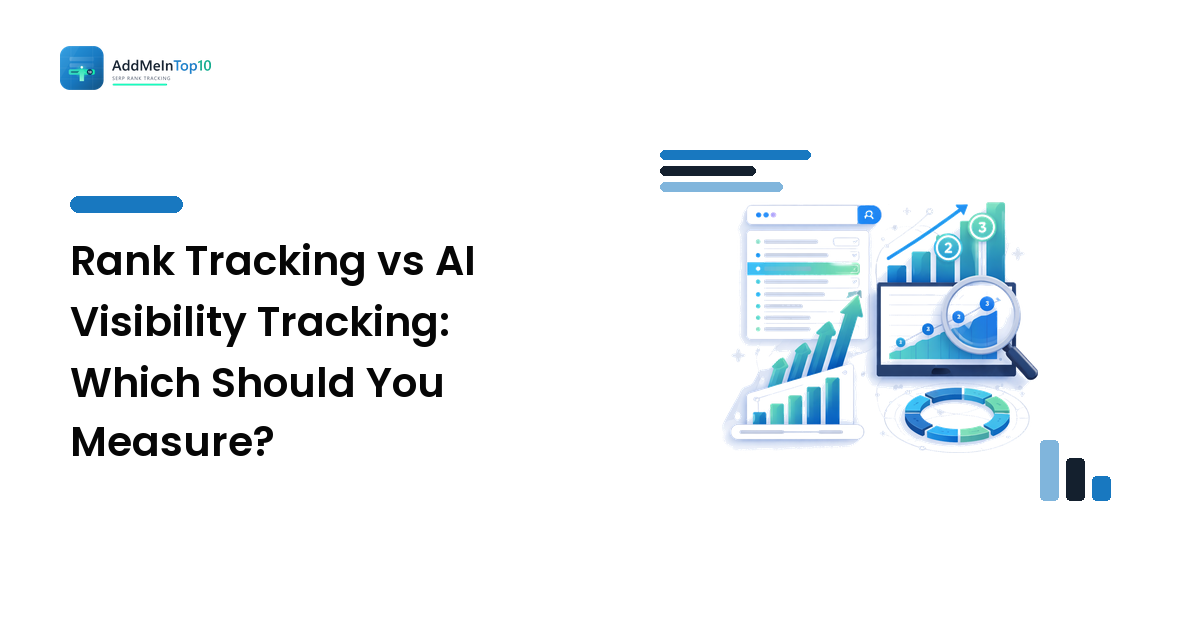
Track classic Google positions as your primary measurement, and treat AI visibility tracking as a secondary, directional signal. Rank tracking produces reproducible numbers you can control for location and device and act on directly; AI answer citations vary between identical prompts, so they tell you roughly how you're doing rather than exactly where you stand.
The reasoning matters more than the verdict, because "measure both" is easy to say and expensive to do badly. Here's what each approach measures, where each falls apart, and how to split your attention without kidding yourself about the quality of the data.
What is the difference between rank tracking and AI visibility tracking?
Rank tracking records your site's position in the SERP (search engine results page) for a specific keyword, from a fixed location, device, and language, on a schedule. The output is an integer: #7, #14, #31. Run the same check under the same conditions tomorrow and you get a number that is comparable to today's.
AI visibility tracking asks whether an AI answer engine — Google's AI Overviews, Perplexity, ChatGPT's search mode — mentions or cites your site when someone asks a question in your topic area. The output is fuzzier: cited or not, where in the answer, with what framing, for a prompt that a real user probably phrased differently anyway.
The critical distinction is not old versus new. It's deterministic versus generative. A ranked list is assembled the same way each time for the same inputs; a generated answer is produced by a model that can legitimately produce a different answer, citing different sources, for the same prompt seconds later. Both are worth knowing about. Only one is a measuring instrument.
How do the two compare side by side?
| Dimension | Classic rank tracking | AI visibility tracking |
|---|---|---|
| What it outputs | A position number (#1–#100) per keyword | Cited / not cited, plus how you're described |
| Reproducibility | High — same location, device, language gives comparable numbers | Low to moderate — identical prompts can yield different sources |
| Location and device control | Explicit and settable per keyword | Limited and inconsistent across engines |
| Input space | Finite keyword list you choose | Effectively unbounded natural-language prompts |
| Historical trend quality | Strong — years of comparable data points | Weak so far — short histories, shifting model versions |
| Diagnosability | High — you can inspect the ranking page and its competitors | Low — you rarely learn why a source was chosen |
| Actionability | Direct: fix intent, title, links, depth on a known URL | Indirect: mostly "rank and be quotable" |
| Cost to run properly | Modest, mature tooling | Higher per check, immature tooling |
| Best used for | Deciding what to work on next and proving it worked | Spotting whether AI surfaces are ignoring you entirely |
Read the table as a hierarchy, not a scoreboard. Rank tracking wins on every property that makes a metric usable for decisions — reproducibility, control, history, diagnosability. AI visibility wins on one thing rank tracking cannot tell you: whether an AI-generated answer is quietly answering your customer's question without ever showing them a link.
Why is rank tracking still the more reliable measurement?
Because you can control the inputs. The whole discipline of honest rank tracking is fixing location, device, and language so that the difference between last week and this week means something — the logic laid out in our guide to tracking Google rankings without fooling yourself. Remove that control and you have anecdotes.
Rank data also comes with a built-in diagnosis path. If you sit at #14, you can open the results page, look at the pages beating you, and see what they do that you don't: match intent more closely, cover a subtopic you skipped, or carry more earned links. That inspection turns a number into a task list — the core of the workflow in our on-page improvements guide.
None of this makes rank data perfect. Positions wobble daily for reasons unrelated to your site, which is why single checks mislead and trends don't — covered in why rankings change every day. But that noise is understood and manageable. The noise in AI citation checks is not yet characterized well enough to separate signal from randomness.
When is AI visibility tracking worth the effort?
There are real cases for it, and it's worth being specific rather than dismissive:
- Your topic gets answered, not clicked. Definitional and how-does-X-work queries are the ones AI answers absorb most readily. If your traffic concentrates there, knowing whether you're the cited source is useful.
- Brand and product queries. How an AI engine describes your product to a prospect is a reputation question, not a ranking question — closer to brand monitoring than SEO measurement.
- Category-level early warning. Not "am I #3?" but "does this surface acknowledge my site exists at all?" — a coarse question a coarse instrument can answer.
What it is not good for is week-over-week performance reporting. Don't build a dashboard that implies precision the underlying data doesn't have, and don't let a client anchor on a number that would have read differently an hour later.
Which should you pick if you can only do one?
Pick classic rank tracking. Three reasons, in order of weight:
First, the data supports decisions. You can act on a position, verify the action, and defend the result. An AI citation check mostly tells you something happened, without telling you what to change.
Second, the work overlaps heavily. Cited sources in AI answers skew toward pages that already rank well organically — these systems retrieve from the same web, often via the same search infrastructure. That's inference from what practitioners observe rather than a published formula, so hold it loosely. But it means earning a top-10 organic position isn't separate from AI visibility work; it's the most plausible route to it.
Third, the leverage is concentrated and findable. Your keywords at #11–20 — the top-10 gap — are pages Google already considers relevant, one page short. That's the highest-return work available to most sites, identifiable today with tooling that exists, as covered in the striking-distance keywords guide. No AI visibility metric points you at an opportunity that precise.
The sane allocation: rigorous scheduled rank tracking on a focused keyword set, plus a manual AI spot-check on your ten most important questions monthly or quarterly. Log what you find; don't chart it as though it were rank data.
How should you evaluate a tool that claims to do both?
Apply the same criteria you'd apply to any tracker — accuracy of targeting first, cadence second, everything else after, as argued in our guide to choosing rank tracking tools. Then add three questions specific to AI features:
- Does it disclose its method? Which engine, which prompt, how many samples per check? A single sample is a coin flip presented as a measurement.
- Does it report variance? A vendor showing how often the answer changed across repeated checks is being honest. A perfectly clean line is smoothing over the most important property of the data.
- Is the AI feature subsidizing a weak core? If location and device targeting are sloppy, an AI dashboard on top doesn't fix that — it decorates it.
FAQ
Is classic rank tracking obsolete now that AI answers exist?
No. Organic positions remain the most reproducible measurement of search visibility available, and they're the input most plausibly connected to being cited in AI answers. What has changed is that a top ranking may earn fewer clicks on some query types, so pair position data with Search Console clicks rather than reading position alone.
Can you track your position in Perplexity or ChatGPT the way you track Google?
Not with the same rigor. There's no stable ranked list to occupy — you're either cited in a generated answer or you aren't, and that can differ between identical prompts. Tools that check it are sampling, not measuring, so treat their output as directional.
Does ranking in Google's top 10 help you appear in AI Overviews?
It appears to help, based on what practitioners widely observe rather than any published weighting. AI answers are generated over retrieved web content, and pages that rank well are more likely to be retrieved. Treat strong organic rankings as the best available foundation, not a guarantee of citation.
What should you report to a client or boss?
Lead with organic positions and their trend over multiple checks, plus clicks and impressions from Search Console. Include AI visibility as a qualitative note — "we're cited for three of our ten core questions, up from one" — clearly labelled as a spot-check rather than a tracked metric.
The honest split of your attention
Measure what you can measure well, and stay curious about the rest. Classic rank tracking gives you controlled, comparable, diagnosable numbers that lead directly to work you can do this week. AI visibility tracking gives you a blurry photograph of a surface that matters more each year but doesn't yet hold still long enough to be measured properly. Treating that photograph as an instrument is how teams end up optimizing for noise.
The work that pays off under both is the same: pages that answer the query better than the ones currently above you, on keywords where you're already close. Add Me In Top 10 is being built around exactly that — scheduled rank checks with proper location, device, and language targeting, movement tracked check-over-check, and a standing list of the keywords sitting at #11–20 where a focused push has the best odds. Find your top-10 gap keywords with Add Me In Top 10 and start with the measurement you can trust.